


The AI customer service space had a breakthrough year. What counted as cutting-edge in 2024 already looks dated in 2026. Prices dropped, automation rates doubled, and a whole new layer of tools shipped that don't just answer questions. They take action. They process returns, issue refunds, update orders, and hand conversations to your team the moment something needs a human touch. Zendesk's latest CX Trends report backs up what every support leader already feels: the bar for what "good" looks like has moved, fast.
That's genuinely exciting news for ecommerce leaders. You've never had more to choose from, and the tools have never been better at what they do. The only catch: picking the right one got harder, not easier, because now every vendor calls themselves AI-powered. Some earned that claim. Some are wearing 2019 chatbots in a 2026 suit. A small handful are genuinely excellent for ecommerce specifically, and that's what this guide is for.
Here's the 2026 rundown. Eight AI customer service tools worth your serious attention if you run an ecommerce support operation. Each gets a real evaluation, not a rerun of their marketing homepage.
How we evaluated these tools
Ecommerce support is its own animal. You get seasonal spikes. You handle returns, shipping questions, sizing concerns, and product inquiries on a weekly cycle. You need your AI to talk to Shopify, not just to Jira. And you definitely don't have six months to train a model from scratch.
With that in mind, here's what we looked at for every tool:
- How fast it goes live. Weeks or months? Do you need an engineering team? Ecommerce teams need velocity, not year-long rollouts.
- What it actually automates. Not "reads your help center." Real workflows: processing returns, issuing refunds, checking order status, updating delivery addresses.
- How well it plays with ecommerce platforms. Shopify, WooCommerce, BigCommerce, and the logistics tools (Shipbob, Returnless, Channable) that run the operation underneath.
- How much control your team keeps. Can you test automations before they go live? Can you roll back a change? Can you see exactly what the AI has been up to?
- How transparent the AI is. When it handles a ticket, can you see why it made a decision? Can your agents step in the moment they need to?
- How pricing works. Per ticket, per seat, per resolution, or a flat managed-service fee?
- Multilingual support that actually holds up. The "we support 50 languages" claim, and whether that's real for Dutch, German, and Nordic markets specifically.
Every tool below gets judged against these criteria.
The quick comparison
ToolBest forSetup timeWho stays in controlNeopleEcommerce brands that want humans in the loopUnder 1 weekYour team, fullyGorgiasEcommerce help desk with native AI2-4 weeksYour teamZendesk AIEnterprise teams already on Zendesk1-3 monthsVaries by tierIntercom FinChat-first support experiences2-6 weeksYour teamTidioSMB ecommerce, especially ShopifyUnder 1 weekYour teamAdaMid-market multi-channel conversational AI4-8 weeksSplit between you and AdaForethoughtMid-market ticket automation on top of your help desk4-8 weeksYour teamFreshdesk CopilotTeams already on Freshworks2-4 weeksYour team
Now the details.
1. Neople
Best for: Ecommerce brands ready to automate up to 80% of their tickets without giving up the reins
Neople was built from day one for one specific thing: ecommerce customer support that actually runs itself. Every Neople (that's what each AI agent is called) arrives ready to handle your highest-volume tickets on day one. WISMO, returns, refunds, sizing, product questions, tracking. It already knows your policies, your tone, and your customers because our team trained it against your historical tickets before it ever went live. And it plugs into the tools you already use (Gorgias, Zendesk, Freshdesk, Shopify, Channable, Returnless), so there's nothing to rip out.
The difference that matters most isn't the AI itself. It's the team behind it. Every Neople comes with a dedicated support crew that onboards you in a week, builds your first workflows alongside you, and keeps adding new ones as your business grows. You don't become the person stuck owning the AI project. We do that part.
What it does well
- Lives in under a week, fully tested against your historical tickets before it ever talks to a real customer
- Handles up to 80% of ecommerce ticket volume end-to-end, not just the first response. Real resolution.
- Every action is fully transparent, with one dashboard, a full audit trail, and one-click rollback on anything that doesn't land right
- Built-in human handoff. When a ticket steps outside the AI's lane, it goes straight to the right person on your team
- Multilingual that holds up across Dutch, German, English, French, and Nordic languages (we tested all of them)
- Pricing is aligned with the outcomes you get, not with seats or users
What it's not trying to be
- A tool for every industry on earth. We stay laser-focused on ecommerce
- A pure self-serve product. We believe the fastest path to results is with a team, not a Getting Started guide
Who's using it: Stoov, Shoeby, Haarspullen, Plein, The Social Hub, and a growing list of European ecommerce brands that move fast and sell volume.
2. Gorgias
Best for: Ecommerce teams who want one tool to do both the help desk and the AI
Gorgias earned its reputation as the ecommerce help desk of choice for Shopify merchants, and its AI products (Automate and Auto-Respond) lean right into that strength. If your team already runs Gorgias, or you're weighing a switch from Zendesk, the built-in AI features are genuinely useful. Automation depth isn't the deepest on the market, but the ecommerce context is baked in from the start.
What it does well
- Tight Shopify, Magento, and BigCommerce integration. Order details, refunds, returns all flow in automatically
- Strong reporting built specifically for ecommerce (revenue per ticket, CSAT by product category)
- Automate feature handles the common ecommerce scenarios out of the box
What to watch out for
- Pricing can climb fast as ticket volume grows, especially with the AI add-ons layered in
- Setup takes longer than dedicated AI tools because you're migrating a whole help desk too
- Automation depth holds up for common scenarios but hits a ceiling on complex multi-step workflows
Who it fits: Ecommerce brands that want one vendor for both the CS platform and the AI layer.
3. Zendesk AI
Best for: Enterprise teams already running Zendesk, with the budget for the full suite
Zendesk shipped a serious AI stack over the last 18 months. Answer Bot, generative AI agents, and intent prediction all sit on top of the core help desk and work together. If your company is already standardized on Zendesk, layering in the AI is the path of least resistance. Just know that "least resistance" here comes with enterprise pricing and enterprise procurement cycles.
What it does well
- Deep integration with the rest of the Zendesk suite (Support, Guide, Chat, Talk)
- Strong for companies with complex routing rules and many support channels running in parallel
- Intent detection and macro suggestions genuinely speed up human agents
What to watch out for
- Pricing gets steep at the tiers where the AI features actually live
- Setup and tuning typically runs one to three months, often with a services partner in the mix
- Not ecommerce-specific, so expect more customization work to get the same outcomes
Who it fits: Mid-market to enterprise brands already embedded in the Zendesk ecosystem.
4. Intercom Fin
Best for: Chat-first support teams that put conversational quality first
Fin was one of the first serious GPT-powered bots to hit the market, and it's grown into a genuinely solid conversational AI for teams where live chat carries most of the support load. It's especially good at natural, on-brand conversations and has steadily added action-taking capabilities over time.
What it does well
- Conversational quality is among the best in the category. It doesn't feel like a chatbot
- Integrates with Intercom's Messenger suite out of the box
- Strong handoff flow to human agents when the conversation needs one
What to watch out for
- Per-resolution pricing can add up fast in high-volume ecommerce
- Focuses more on chat than on ticket-heavy email or form-based support
- Ecommerce-specific workflows (refunds, returns, order lookups) require more configuration
Who it fits: DTC brands where chat is the primary support channel and brand voice is a priority.
5. Tidio
Best for: Smaller ecommerce brands on Shopify who want something up and running today
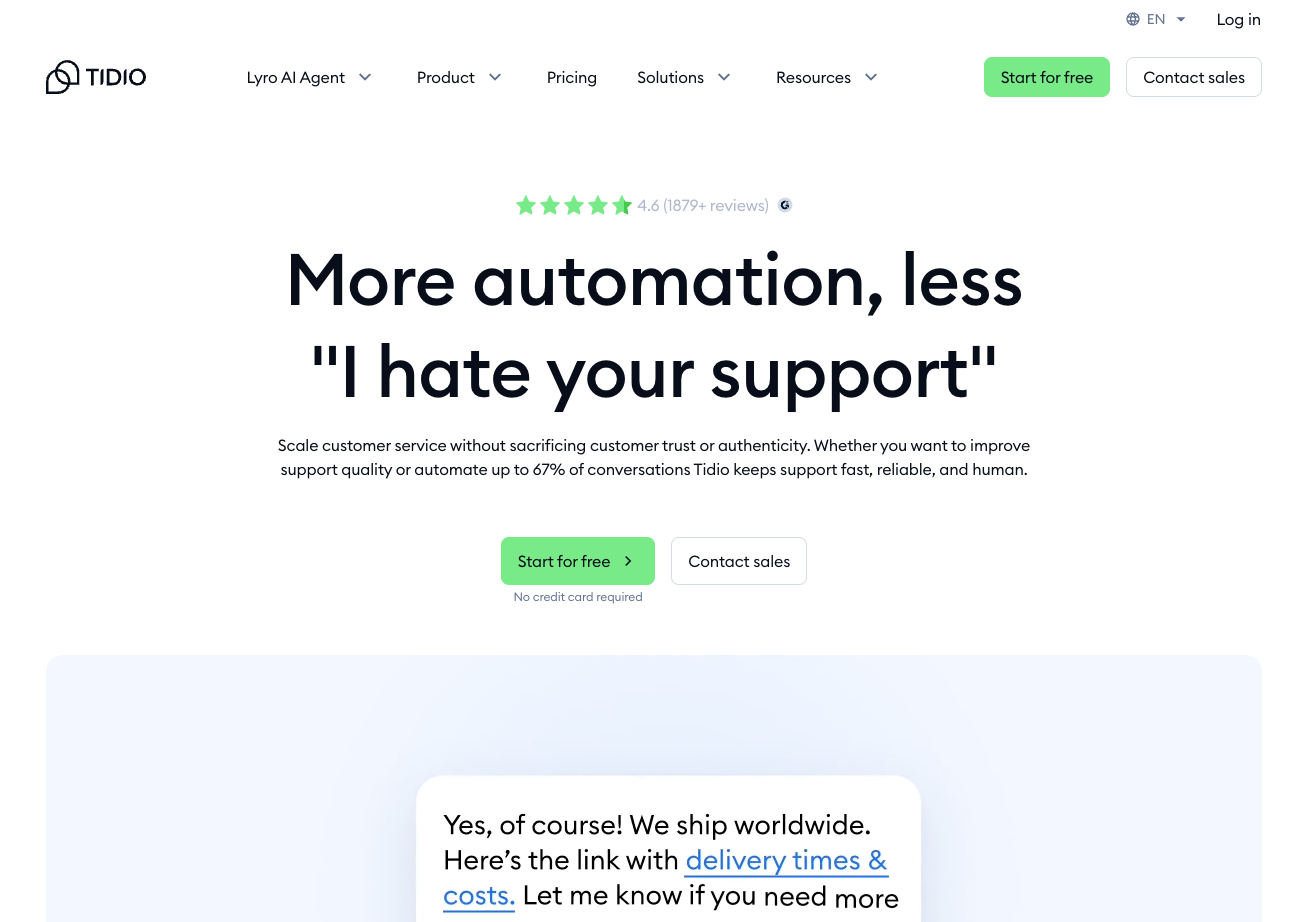
Tidio is the accessible choice for small and mid-size Shopify merchants. Lyro, its conversational AI assistant, ships alongside a solid live chat product. For brands that can't justify the cost or complexity of Gorgias or Zendesk, Tidio hits a genuine sweet spot.
What it does well
- Fast setup, often same-day for basic deployment
- Strong Shopify integration for common scenarios
- Entry-level pricing is friendly for small teams and scales reasonably with volume
What to watch out for
- Automation depth is lighter than the enterprise tools. Multi-step workflow execution isn't really its game
- Reporting and analytics are solid but not deep
- Once you get past a certain ticket volume, you'll likely outgrow it
Who it fits: Shopify merchants under 5,000 monthly tickets who want to get moving fast.
6. Ada
Best for: Mid-market brands that want conversational AI across multiple channels
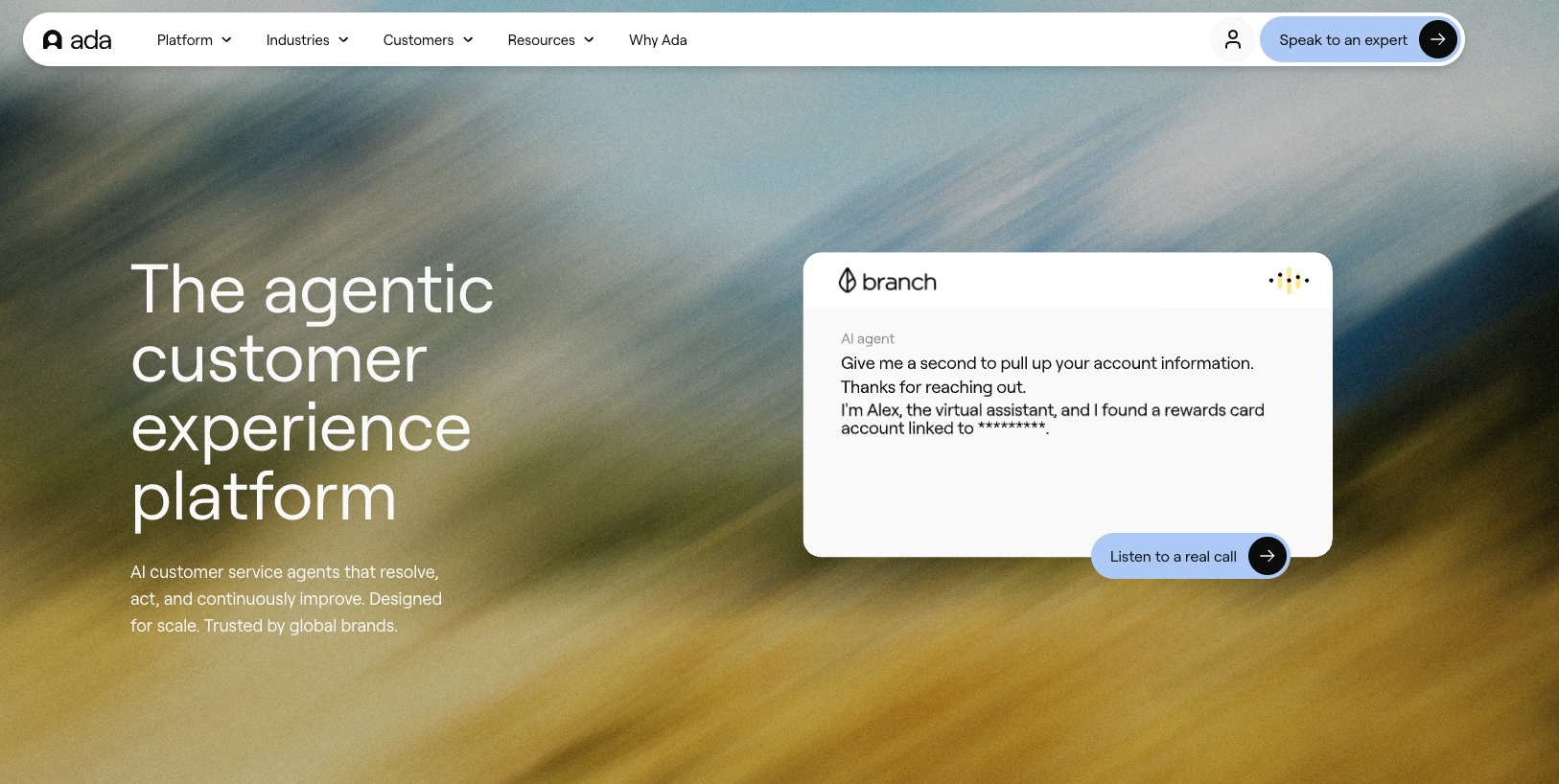
Ada built its product around the idea of a brand-specific AI agent that learns your policies and handles conversations across web, chat, SMS, and voice. It's earned a solid reputation for conversational quality and has leaned harder into action-taking in the last year.
What it does well
- Multi-channel from the start. One AI across chat, email, SMS, voice
- Strong enterprise presence with polished analytics
- Handles fairly complex conversations well once properly trained
What to watch out for
- Setup runs four to eight weeks and involves meaningful training time
- Control over what the AI actually does on a given ticket is less granular than newer tools
- Not ecommerce-specific, though it works fine in ecommerce settings
Who it fits: Mid-market brands that prioritize multi-channel consistency and brand voice.
7. Forethought
Best for: Teams that want intelligent ticket routing and answer suggestions layered on top of their existing help desk
Forethought positioned itself as the AI layer that sits on top of Zendesk, Salesforce, and Freshworks to speed up ticket resolution. Its strength is in predicting intent, suggesting answers to agents, and routing tickets smartly. The autonomous agent side has grown over time, but the core value still leans toward assist-the-human rather than fully-handle-the-ticket.
What it does well
- Intent prediction is genuinely strong
- Agent assist features meaningfully reduce average handle time
- Integrates cleanly with the major help desks
What to watch out for
- More of an assist layer than a full automation platform
- Ecommerce-specific flows need more configuration to sing
- Pricing is aimed at mid-market and up
Who it fits: Support teams that want AI to help their humans first, automate second.
8. Freshdesk Copilot
Best for: Brands already running on Freshworks who want the AI layer integrated
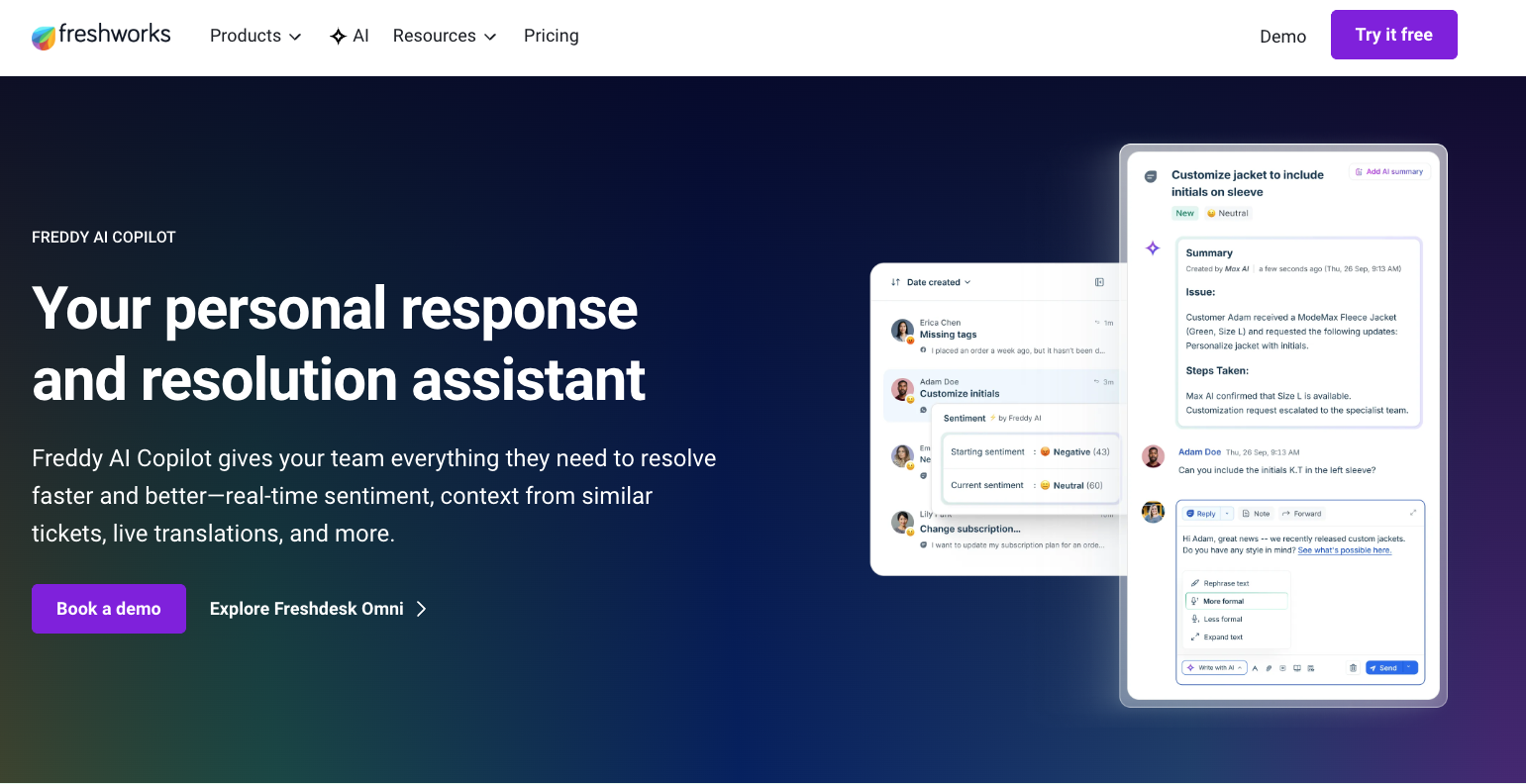
Freshdesk Copilot is Freshworks' answer to the Zendesk and Intercom AI products. It's been steadily improving and now delivers a credible automation layer for ticket resolution, agent assist, and basic bot experiences. If you're on Freshdesk already, this is your fastest path to AI.
What it does well
- Native integration with the Freshdesk suite
- Agent-assist features are strong and move the needle on productivity
- Pricing is more accessible than comparable Zendesk AI features
What to watch out for
- Not ecommerce-specific. General-purpose features need tuning for retail workflows
- Automation depth is still catching up to the dedicated AI platforms
- Multilingual quality varies by language
Who it fits: Brands already on Freshworks who want the integrated AI layer without switching vendors.
How to pick the right one for you
Eight tools is still a lot. Here's a faster way to narrow it down based on where you are right now.
If you run an ecommerce brand with 1,000+ tickets a month and want to automate without giving up control, Neople is built for exactly this. Under a week to go live, full transparency, and a team that sticks with you.
If you're on Shopify and want something fast, Tidio works well for smaller brands. Gorgias makes sense if you want a full help desk and AI in one.
If you're already on Zendesk or Freshdesk at enterprise level, use the native AI layer (Zendesk AI or Freshdesk Copilot). The integration value usually outweighs the trade-offs.
If chat conversation quality is your top priority, Intercom Fin is hard to beat.
If you need AI across chat, email, SMS, and voice, Ada is built for that specifically.
If you want AI that makes your human agents faster rather than replaces them, Forethought is designed around exactly that use case.
Frequently asked questions
What's the cheapest AI customer service tool for ecommerce?
The honest answer: "cheapest" depends entirely on how your support volume behaves. Self-serve tools with per-seat pricing look cheap on the starting page but add up fast as your team grows. Platform-bundled AI (Zendesk, Intercom) looks more expensive, but you're getting the help desk and the AI together. Tools priced by outcomes or resolutions scale differently again. The better question isn't which is cheapest. It's which pricing model matches how your costs should actually grow, and the only reliable way to answer that is to get quotes from the vendors on your shortlist based on your real ticket volume.
Which AI customer service software works best with Shopify?
Gorgias, Tidio, and Neople all have strong Shopify integrations. Gorgias is built natively around Shopify. Tidio is Shopify-first for the SMB segment. Neople connects through Shopify Plus or standard Shopify APIs and handles order lookups, refunds, returns, and tracking automatically. Zendesk and Freshdesk both offer Shopify connectors, though they're less polished.
How long does it take to implement AI customer service?
Anywhere from same-day to six months depending on the tool. Tidio and Neople can both be live in under a week. Intercom and Gorgias typically take two to six weeks. Zendesk AI, Ada, and Forethought usually run one to three months, often longer at enterprise scale. If a vendor quotes you an implementation longer than four weeks, ask what exactly is being done in that time and why.
Will AI replace my support team?
No, and you wouldn't want it to anyway. The best AI customer service tools handle the repetitive high-volume tickets (WISMO, returns, refunds, basic FAQs) so your human agents can focus on the complex cases, the relationship-building moments, and the VIP customers. Research consistently shows that AI works best as a co-pilot for human agents. McKinsey's 2024 research on generative AI in customer operations found that teams pairing AI with human agents saw productivity gains of up to 40% without reducing headcount. Teams using tools like Neople typically see AI handle 60-80% of volume while their human team grows in value, not shrinks in headcount.
What's the difference between an AI agent and a chatbot?
A chatbot follows scripts and decision trees. It only answers questions it's been explicitly programmed to handle. An AI agent uses large language models to understand intent, take action across systems (issue a refund, update an order), and handle conversations it wasn't scripted for. Most tools on this list are AI agents. Some older Gorgias and Zendesk products are closer to classical chatbots, though the line blurs more every month.
How do I know if an AI tool will work for my specific ecommerce business?
Give it your historical tickets and see what it would have done. Every serious vendor (including Neople) should run your actual past tickets through the AI during onboarding and show you exactly what decisions it would have made. If a vendor won't do this, that tells you something.
Where to go from here
The AI customer service market is in genuinely good shape right now. Whichever tool you end up picking, you're almost certainly going to be better off than you were twelve months ago. The real job is matching the tool to how your ecommerce team actually works, not chasing the slickest-looking marketing site.
If you're an ecommerce brand hunting the shortest path from "exploring AI for support" to "80% of tickets automated," book a 30-minute demo and see how Neople stacks up against your current setup. If your real question is whether AI will work for your specific ticket mix and volume, we'll run your historical tickets through a Neople and show you the numbers. No slide deck required.




.avif)

.avif)